How to Forge a Traditional Hand-Forged Door Knocker
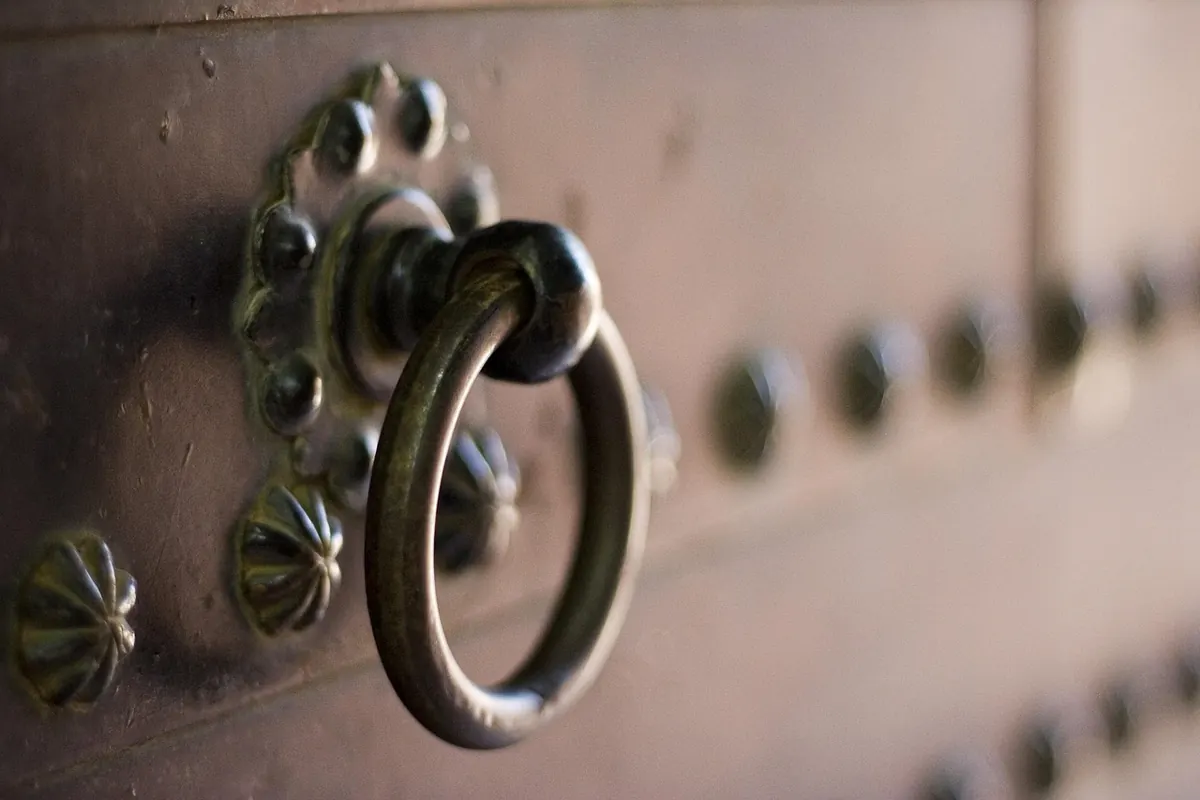
A door knocker hides nothing. The scrolls have to match each other, the hinge has to swing true, and every joint sits in plain view for the next fifty years. It is also a compact project — a little over a metre of stock and an afternoon at the forge — and it teaches the three techniques that turn up in almost everything else you will make: scrollwork, tenons and rivets.
Draw it out before you light the forge
Work at full size on a piece of MDF or stiff card. A knocker that looks sensible as a thumbnail sketch often turns out to be a lump of iron once it is drawn properly.
My go-to proportions: a backplate around 130mm tall and 90mm wide, carrying matched scrolls at the top and bottom, with a knocker arm roughly 200mm from pivot to striker. The pivot sits at the top of the plate and the arm hangs down past it, so gravity does the work of returning it after a knock. Sketch the arc of the swing, mark where the striker meets the buffer plate, and decide now whether the hinge will be a forged eye wrapped round a pin or a simple pivot riveted through two lugs. The second is easier and looks no less traditional.
One fitting note to settle early: the centre of the knocker usually sits about 1.5 metres above the ground, which is comfortable for most hands. Mark that height on your drawing so the proportions are judged in context.
Steel and tools
Use clean mild steel. Never forge galvanised, zinc-plated or painted stock — the fumes are genuinely harmful and the coating ruins the surface anyway.
- 12mm square bar, about 500mm, for the backplate frame
- 10mm x 6mm flat bar for the scrollwork, roughly 600mm
- 12mm square for the knocker arm, around 250mm
- 10mm round for the pivot pin, 6mm round for rivets — or make the tenons do the riveting
- A scrolling fork and a scroll wrench, or a bick with a good taper
- Hot cut, half-round file, bolster, 1kg cross-peen and a smaller ball-peen hammer
Two hammers is not a luxury here. The cross-peen draws and shapes; the ball-peen heads rivets and forms the striker knuckle.
Scrollwork on the backplate
Forge the frame first: square the corners, then taper and feather the ends of the flat bar. Scrolls always read better when the tail thins as it curls.
Start the curl over the bick or scroll wrench at a good bright orange, and bring the first 30mm round a little at a time. Then work the rest of the scroll in stages, reheating as soon as the colour drops to cherry red. Cold bending shows as faceted, lumpy curves and no amount of filing hides it.
The trick to matching a pair is to make the first scroll completely, then hold it beside the second at every stage of the second one's forming. Compare iron to iron, not iron to drawing — the drawing never lies, but your eye will.
Brush the work with a wire brush as it cools through dull red to shift the scale. Do this while it is still too hot to touch but no longer glowing, and the surface comes up silvery.
Forging the arm and the striker
Keep the weight near the pivot. A heavy-ended arm swings like a pendulum and rattles; a light-ended one feels dead. Draw a gentle taper from the hinge back towards the striker, leaving a slightly thicker section right where the pivot passes through.
For the striker, upset the end of the bar to gather material, then forge a knuckle — a curl of about three-quarters of a turn — or a small ball formed with the ball-peen. The knuckle is the older look and takes a knock better because the curve springs rather than dents.
Making the tenons
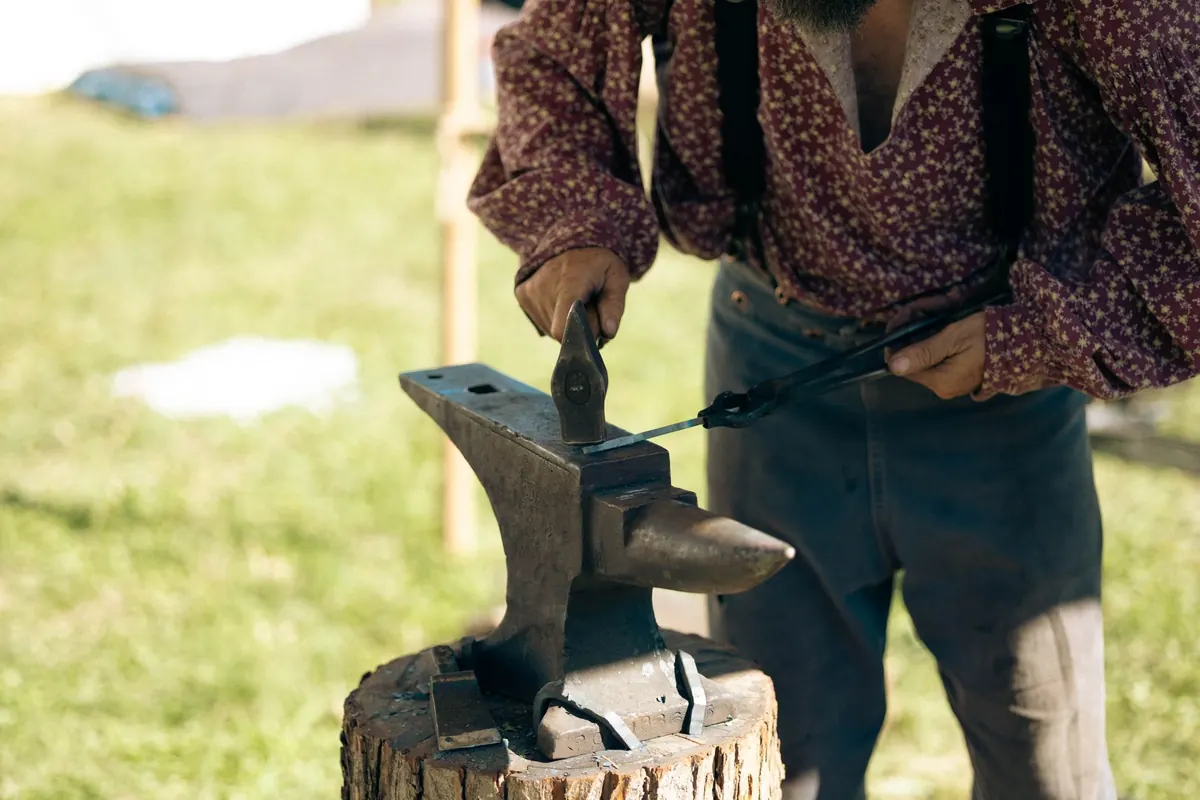
A tenon is just a shank drawn down from a larger section, and the whole job rests on the shoulder. Heat the end, hold it over the anvil edge and hammer down with the cross-peen, rotating a quarter turn between blows. If you draw it to a taper rather than a parallel shank, it will fill the hole tightly as you drive it home.
Leave the shoulders crisp. Square them up with a couple of light hammer blows against the anvil face, then check the tenon fits its drilled hole with a file if needed. Aim for a firm push fit — not a rattle, not a fight.
Riveting it together
Rivets are the honest way to join forged work, and there is no need to buy them. Cut 6mm round bar to length — roughly one and a half times the diameter beyond the plate — heat it, drop it in, and head the tail with the ball-peen while the shank is at a good orange. Work around the head in quick, light blows rather than one heavy thump, and it will fill the hole and pull the joint tight.
Leave the hinge slightly free. Peen the pivot pin enough to hold, then work the arm back and forth while it is still warm so it does not seize. A dab of graphite or a smear of grease will keep it moving for years.
Finishing and fitting
Brass-brush the whole piece at black heat for a warm, slightly golden colour, then wax it while still warm. For an external door, be realistic: wax and oil need redoing once or twice a year, and a knocker left to itself will go a fine dark brown and eventually rust. If low maintenance matters more than finish, a good metal paint is the more sensible choice.
Fitting takes ten minutes if you have thought about the door. Hold the knocker at your marked height, swing the arm and check it clears the door face and any mouldings. Fix through the backplate with screws long enough to reach solid timber — but check what the door is made of first. Composite and hollow doors need different fixings, and drilling into them may affect a manufacturer's guarantee, so ask before you start. Avoid drilling near glazed panels or the lock case, and pilot every hole.
Photo: lesia_design / Pixabay